Master soft plastic shad baits, a versatile category of swimbaits designed to imitate baitfish. Learn why their flat bodies create flash, how to use them with jig heads or Texas rigs, and key retrieval techniques for bass and other predators.
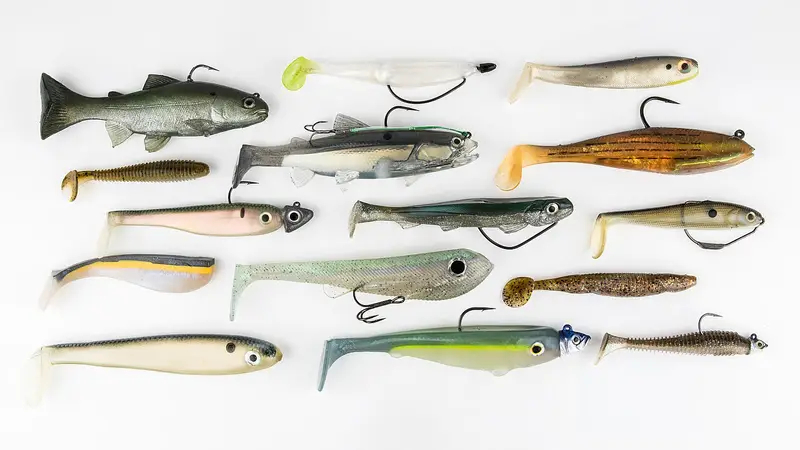
What are Soft Plastic Shad Baits? (Soft Swimbaits / Paddle Tails)
Soft plastic shad baits, often simply called soft swimbaits or paddle tails, are a category of soft lures designed to closely mimic baitfish like shad, herring, and other common prey. They share a similar profile with hard minnow lures but are made of soft, flexible plastic and typically have a flattened body. This flat shape is key: as the bait moves through the water, it catches light and creates a strong, realistic flash that mimics the scales of a fleeing baitfish. Their lifelike action and versatility make them a top choice for a huge range of predatory fish.
Key Features
- Flattened Body Profile: Unlike a round worm, shad baits are often flattened from side to side. This creates a wide surface that reflects light, producing a strong flash that attracts fish from a distance.
- Lifelike Action: The soft plastic and paddle or forked tail create a tight, swimming action with just a steady retrieve. This perfectly mimics a swimming baitfish.
- Versatile Rigging: They can be fished on a jig head, Texas-rigged, Carolina-rigged, or used as a trailer on a swim jig or spinnerbait.
- Target Species: Highly effective for a wide range of predators, including largemouth and smallmouth bass, striped bass, walleye, pike, snakehead, and many saltwater species like speckled trout and redfish.
How to Rig Soft Plastic Shad Baits
The most common and effective way to fish a soft shad bait is on a jig head. The weight helps you cast and controls the depth.
- Jig Head Rigging: Simply thread the bait onto a jig head hook, making sure it sits straight. The jig head's weight and shape will affect the action. A round ball head is versatile, while a swim jig head is designed for a more horizontal swimming action.
- Texas Rig (Weedless): For fishing in heavy cover like weeds or rocks, you can rig a shad bait Texas-style with a bullet weight and an offset hook. This makes the bait virtually weedless while still allowing a good swimming action.
- Carolina Rig: For deep water, a Carolina rig with a leader allows the shad bait to float and swim freely above the bottom.
- Swim Jig Trailer: Shad baits make excellent trailers on a swim jig, adding bulk and action to the jig.
Fishing Techniques: Making the Shad Come Alive
The great thing about soft shad baits is that they are incredibly easy to fish. Their built-in action does much of the work.
The Standard Retrieve: Steady Does It
This is the most fundamental and effective technique. Cast out, let the bait sink to the desired depth (using a countdown), and then begin a steady retrieve. The speed can be varied. A steady, medium-paced retrieve will make the tail kick and the body swim, creating a realistic baitfish imitation. This is a perfect search bait technique to locate active fish.
Varying Your Speed (Cadence Control)
Don't be afraid to experiment with your retrieval speed, a concept known as cadence control. A slow, steady retrieve can be effective in cold water or for lethargic fish. A fast, "burning" retrieve can trigger reaction strikes from aggressive fish. The key is to find what the fish want on that particular day.
The "Stop-and-Go" Retrieve
To mimic a wounded or fleeing baitfish, use a stop-and-go retrieve. Reel steadily for a few turns, then pause for a moment. During the pause, the soft bait will stop its forward motion and begin to sink or flutter. This sudden change in action can be irresistible to following fish. This is a highly effective technique for suspending fish or when they are following but not committing.
Fishing Different Depths
You can control the depth by using a countdown method and adjusting your retrieve speed.
- Shallow Water: Start reeling immediately after the cast.
- Mid-Depth: Let the bait sink for a few seconds (count 1-5) before starting your retrieve.
- Deep Water: Let it sink for a longer count, and use a slower retrieve to keep it deep.
Why Soft Shad Baits are Great for All Anglers
Their simplicity, versatility, and effectiveness make them a must-have. They are often recommended as a best choice for beginners because they are easy to rig and fish—just cast and retrieve. For experts, the ability to fish them at various depths, with different retrieves, and in heavy cover makes them an indispensable tool.
Pro Tip: Always check your shad bait after a few casts or after a fish. The soft plastic can get torn or slid down the hook, ruining the action. Re-positioning it or replacing it will keep the tail kicking correctly. Also, using a fluorocarbon leader can help the bait run truer and be less visible in clear water.