Master soft plastic grubs, including curly tail grubs and twin tails. Learn why their kicking tails and subtle action make them deadly for bass, panfish, and more. Discover key rigging techniques (jig head, Texas rig) and retrieval methods.
What are Soft Plastic Grubs? (Curly Tail / Twin Tails)
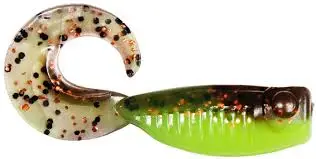
Soft plastic grubs are among the most versatile and effective soft baits in any angler's tackle box. They consist of a soft plastic body, typically with a curled or ribbon-like tail, molded on a single hook or designed to be rigged on a jig head. Their simple design creates an incredibly lifelike action: when retrieved or lifted, the tail kicks, flutters, and vibrates, perfectly mimicking a baitfish, leech, crawfish, or insect. They are a staple for both beginners and experts, effective on a huge range of species in freshwater and saltwater.
Key Features & Types
- Curly Tail Grubs (Single Tail): The most common type. Features a single, curled tail that rotates and kicks with the slightest movement, creating vibration and flash. Excellent for a wide variety of retrieves.
- Twin Tail Grubs: Features two curly or ribbon tails. This creates a bulkier profile and more water displacement, imitating a crawfish or larger baitfish. The twin tails also have a slower, more enticing fall. They are a top choice for finesse fishing and when fish are less active.
- Body Styles: Grubs come in various body shapes, from slender to fat, and in countless colors. Common colors include natural shad tones, chartreuse, black, and motor oil.
- Scent and Salt: Many soft plastic grubs are impregnated with salt or scent, which makes them taste less appealing to fish that mouth them and can trigger them to hold on longer, improving hook-up ratios.
Target Species
Soft plastic grubs are incredibly versatile and work on a huge range of predators.
- Freshwater: Largemouth and smallmouth bass, crappie, bluegill, perch, walleye, trout, and snakehead.
- Saltwater: Inshore species like speckled trout, redfish, flounder, and snook.
How to Rig Soft Plastic Grubs
The most common and effective way to fish a soft plastic grub is on a jig head. The weight of the jig head helps you cast and controls the depth.
- Jig Head Rigging: Simply thread the grub onto the jig head hook, making sure it sits straight. The jig head's weight and shape (round, football, etc.) will affect the fall rate and action.
- Texas Rig: For fishing in heavy cover like weeds or rocks, you can rig a grub Texas-style with a bullet weight and an offset hook. This makes the bait virtually weedless.
- Shaky Head: A shaky head jig is a specialized jig head designed for a subtle, quivering action, perfect for finesse presentations with a grub.
Fishing Techniques: Making the Tail Work
The key to success with grubs is making the tail kick and flutter. The action is created by movement, so the retrieve is critical.
The Standard Retrieve: Steady and Slow
This is the most fundamental technique. Cast out, let the grub sink to the desired depth (using a countdown), and then begin a steady, slow to moderate retrieve. The constant movement will make the tail kick continuously. This is a great search bait technique to locate fish.
The "Lift and Drop" (Hop)
This technique is deadly for fishing deep water or along the bottom. Cast out and let the grub sink. Then, lift your rod tip sharply to make the grub "hop" up off the bottom. Then lower the rod tip and let the grub sink back down on a semi-slack line. The tail will kick and flutter during both the lift and the fall. Most strikes occur during the fall. This is a classic vertical jigging technique from a boat, but also works from shore.
The "Swim and Pause"
Reel steadily for a few turns, then pause for a moment. During the pause, the grub will stop and begin to sink, its tail still fluttering slightly. This sudden change in action can trigger strikes from following fish.
Slow Rolling
In cold water or when fish are lethargic, a very slow, steady retrieve can be highly effective. The goal is to barely move the bait, just enough to make the tail quiver.
Why Soft Plastic Grubs are Great for All Anglers
Their simplicity, versatility, and effectiveness make them a must-have. They are often recommended as a best choice for beginners because they are easy to rig and fish—just cast and retrieve. For experts, the ability to fish them at various depths, with different retrieves, and in heavy cover makes them an indispensable tool for finesse fishing and triggering bites from pressured fish.
Pro Tip: Always check your grub after a few casts or after a fish. The soft plastic can get torn or slid down the hook, ruining the action. Re-positioning it or replacing it will keep the tail kicking correctly.